Bespoke pool and retaining scope
Pool Drainage and Waterproofing Brisbane
Pool drainage and waterproofing coordination suits a site where water needs to be considered across the pool edge, retained ground, paving, garden and existing structures. It is not a universal detail or a substitute for project-specific design. It is the practical work of making current water observations part of the brief before hard surfaces and excavation change the site.
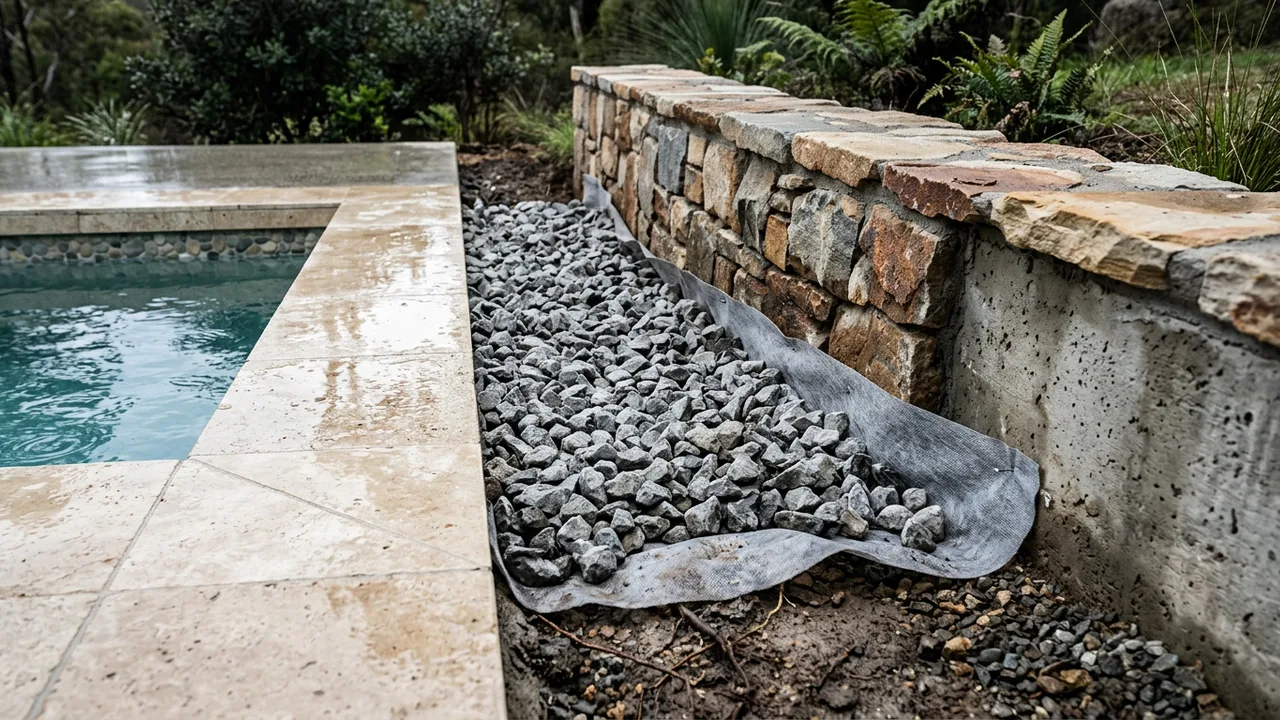
Pool retaining wall planning for drainage and waterproofing
Start with photos after rain if they are available, plus notes on downpipes, low points, existing drains, garden beds and any areas that remain wet. That information helps a provider understand the questions to raise about the actual pool and wall arrangement rather than relying on a generic drainage promise.
What the project scope brings together
The review connects current water behaviour with the future pool, wall and finished-level decisions that may alter it.
Surface-water pathway review
Subsoil drainage coordination
Waterproofing interface questions
Finished-level water management
Map where water goes now
A backyard already has water paths, whether they are obvious only after a storm or visible in the shape of garden beds and paving. Note the direction of fall, collection points, downpipes, existing drainage points and the boundary between hard surfaces and planted areas. These observations are not a drainage design, but they are stronger than a blank assumption that water will find a suitable route later.
Coordinate pool drainage with finished levels
Coping, paving, garden transitions and wall tops all contribute to the finished levels around a pool. When those elements are considered separately, a small adjustment in one area can send water toward another interface. Discuss the desired movement through the outdoor area, not merely the visual finish, so the eventual details can be assessed against the same site plan.
Waterproofing belongs at the interface, not as an afterthought
Where a retaining arrangement, pool surround or adjacent structure creates a water-sensitive interface, ask what information is needed before selecting a detail. Material choices, drainage pathways and the construction sequence may all affect that answer. Avoid assuming that a named product or a one-line allowance resolves the question without reference to the actual wall and ground conditions.
Keep maintenance questions visible
The completed pool area will still need to manage leaves, garden growth, surface water and the practical access needed to inspect or maintain relevant components. Ask how the proposed layout allows those everyday tasks to happen. The maintenance approach depends on the actual project, so discuss the finished result as well as the construction phase.
A practical project-review sequence
Water-management questions are most useful when they are recorded before the pool layout and surrounding surfaces are finalised. Keep the current drawings with the proposal so changes to levels or access can be traced before work starts.
- 01
Observe runoff
Collect photos and notes about low points, downpipes and wet areas.
- 02
Overlay the proposal
Set the likely pool, wall and paving levels against current water paths.
- 03
Clarify interfaces
Ask what drainage or waterproofing questions need design input.
- 04
Check the final scope
Confirm inclusions, exclusions and maintenance access in writing.
Why this early brief matters
Evidence before assumption
Current water observations give the project conversation a factual base.
Joined finished levels
Pool edges, surfaces and retained ground are considered together.
Long-view questions
Maintenance and access are raised before the layout becomes fixed.
Pool Drainage and Waterproofing questions
How does the retaining wall affect pool design and placement?
Is reinforced concrete the only suitable option for a pool retaining wall?
What questions should I ask a pool installer about engineering reports?
How do quotes for slope pools vary between contractors in Brisbane?
How should a retaining wall system be selected for a Brisbane pool?
Pool Drainage and Waterproofing across Brisbane
Select a Brisbane suburb for pool drainage and waterproofing context before requesting a project review.
Talk to a specialist
Discuss pool drainage and waterproofing
Use post-rain observations and the proposed pool layout to frame a water-management conversation.